
Purity–Book Review

purityfranzen

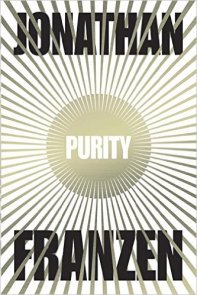
Like a lot of other people on the planet, I loved The Corrections, Jonathan Franzen’s acclaimed 2001 novel about a dysfunctional Midwestern family.  I hazard to say that I liked 2010’s Freedom somewhat less, and now that I’ve just finished it, 2015’s Purity a little less still.

There is no denying Franzen is a fine writer.  His characterization is full and compelling, built upon revealing and often relatable anecdotes.  Franzen has a gift for vividly portraying tortured relationships, whether they be parent and child, husband and wife, co-workers or partners in crime.  This is what made The Corrections so much fun to read.  Although no actual family could be messed up in the precise ways the Lamberts are, readers can still recognize the agony that comes from decades of responses to family members which trigger counter-responses.  Suffice it to say that what rings true in The Corrections is the power that family has on us; at times, it’s a power that has us laughing aloud and at other times has us holding back tears of a very different nature.   Another strength of Franzen is his ability to keep a story moving forward while switching the focus from one character to another.  This achieves the effect of forcing the reader to constantly re-evaluate characters in light of new information and how others see them.  Finally, there is the fact that reading a Franzen novel is illuminating about very specific niches of our contemporary world.  Purity is convincing whether Franzen is writing about a secretive internet organization dedicated to leaking information that is damaging to the rich, powerful and environmentally destructive, painting a portrait of paranoid, repressive and corrupt East Berlin before the wall fell, detailing post-graduate film projects that border on performance art, or casting light on the anxiety of an independent journalist trying to verify her sources and beat the established papers to a big scoop.

The title is apt, referring as it does to the name of one of the protagonists of the 608 page novel, but also to the thematic concern of whether it’s possible to be pure in such an impure world.  A number of characters commit vile acts in the novel, but many claim to have pure intentions in carrying them out.   Just how much weight should purity of intention carry?  It’s an important and relevant question.

So what’s not to like?  Well, sections of the book just went on too long.  In particular, the chapters dealing with internet sensation Andreas Wolf seemed endless.   When I find that I am repeating to myself ‘just get through this section and it will be enjoyable again soon enough’, maybe it’s time to put the book down and get another.  While the other Franzen novels I’ve read didn’t seem lengthy, this one did.  Frequently.  Perhaps well-respected and successful novelists have difficulty finding editors who will tell them the truth, even if it’s not flattering.  Purity could easily have shed 100 pages, maybe more and been more effective.  Whereas in The Corrections, the relationships are beyond our experience but still somehow familiar, in ­Purity, they seem to be so excruciating that they are almost unrecognizable.  I felt this way to a certain extent about Richard Katz, the hedonistic musician in Freedom, but Anabel Laird and Andreas Wolf take this alienation of reader and character to a whole other level.  The characters are so extreme in what they need from one another and come from such uncommon backgrounds that the novel seems less a revelation about modern living than a mystery accompanied by dashes of social commentary.

Would I like to be able to write like Jonathan Franzen?  You bet.  I just hope his best work isn’t behind him.

Donald Trump: The Logical Outcome of Politics as Entertainment

As I write this, the U.S. election is 23 days away.  Much of the world is horrified at the possibility that Donald Trump could become the next president of the United States.  A good portion of that horror seems to result from the amazement that Trump does not horrify everyone.  Such a view, however, does not take into consideration the history of American politics, nor for that matter of politics in an age dominated by visual technology.  In other words, sad as it is to say it, the fact of Trump, or someone like minded and equally unfit, as President is a logical outcome of politics in the digital age.

A look at U.S. presidents since F.D.R. is instructive.  Roosevelt himself, often considered one of the most effective presidents of all time, campaigned in the era of radio.  To indicate what a different world he lived in, many voters had no idea that Roosevelt was in a wheelchair.  Voters knew F.D.R. through radio and through very selective photographs.  Can you imagine F.D.R. or his successor, Harry Truman, even getting nominated in our visual age?  As Neil Postman pointed out in his excellent book Amusing Ourselves to Death, “if politics is like show business, then the idea is not to pursue excellence, clarity or honesty, but to appear as if you are…In America, the fundamental metaphor for political discourse is the television commercial.”  Postman wrote this in 1985 and would have probably been dismayed but not surprised, that after his death in 2003, the metaphor has changed to something even less substantial:  the meme.

Following Truman of course, was Dwight Eisenhower.  Though not blessed with matinee idol looks, Eisenhower was a war hero and was operating in television’s infancy.  By 1960, with television gaining a firmer foothold, Kennedy trumped Nixon and prompted the now almost legendary comment that “if you listened to the presidential debate on radio, you thought Nixon won, but if you watched him sweat and squirm on T.V. next to Kennedy’s ease, you thought Kennedy won.  By 1964, a television ad played a prominent role in L.B.J. defeating Barry Goldwater; the controversial mushroom cloud in the commercial called Daisy powerfully played on voters’ fears of nuclear war as a real possibility if the hawkish Goldwater was elected.  It’s true that Nixon was elected in both 1968 and 1972, but he defeated Hubert Humphrey and George McGovern respectively, hardly experts at image management.  And can you think of a less polished visual politician than Gerald Ford?  He singlehandedly put Saturday Night Live on the map with the rich material he provided for parody.  In fairness to Ford, after Watergate, it would have taken a miracle for the Republicans to win in 1976.  Perhaps that’s why the matinee idol surfaced four years later.  Ronald Reagan was an actor and generally dismissed nationally in the 1960s and 1970s as a politician out of touch with the times.  But his experience as an actor made him perfect for the modern age of politics.  In a poll conducted in 2013, Americans chose him as their favourite president of the last 100 years.  It is quite likely that despite his declining health, if American law allowed him to run for a third term, he likely would have been elected again in 1988.  It appears that even when reflecting back on Reagan’s legacy, it does not matter if he “made America great again” so much as if he appeared to do so.  Trump obviously recognized the continued power of this slogan, even if he refuses to credit its author.  But as Postman says, context and history is incompatible with the visual age of communication.  So Trump can get away with a legion of astounding lies because he is not challenged in the visual present, but largely in the outmoded medium of print.  Unfortunately, truth is largely irrelevant in politics played out in the visual realm.

If we exclude the election of 1988 because Reagan’s popularity was still so sky high and rubbed off on Bush Sr., it can be argued that every election since then has seen the more aesthetically pleasing candidate win.  Fortunately, sometimes the pleasing image was also the better choice (Barack Obama); at other times, it was a shockingly inferior choice (George W. Bush).  I would argue that Trump’s experience in front of television cameras has sadly meant more to many voters than all his asinine, racist, sexist, and patently untrue remarks.  Only in a world where political discourse is visual in nature could a Middle Aged White billionaire with a long history of racist and sexist actions bill himself as an outsider and get away with it.

As if this isn’t depressing enough, even if we are fortunate enough to see him defeated in November, along will come a visually savvy and amusing candidate equally bereft of important ideas, but less prone to offensive statements who will win in a Reaganesque landslide.  Will we be too busy watching memes on small screens to notice?


Bob Dylan, Nobel Laureate!

dylan-picture

I was as surprised as anybody when I heard that Bob Dylan won the Nobel Prize for Literature today.  Not that I think he is unworthy.  On the contrary, I have been a Dylan fan since my brother introduced me to him some 45 years ago.  For decades, I defended Dylan against various allegations made against him including ‘he can’t sing’, ‘he steals from others’, ‘he doesn’t communicate with his audience during live performances’, ‘he’s a self-hating Jew’, and ‘he’s overrrated’.  After a while, I stopped defending Dylan and just smiled at his detractors.  I guess I had come to the realization that nothing I was going to say would likely change their mind, just as nothing they could come up with was going to transform my opinion.

That Dylan is a superior lyricist who influenced countless musicians who in turn have had a significant impact, is, I believe, abundantly clear.  Now whether I would classify his work as literature is not as clear.

Part of this is due to the fact that “literature” is not an easy concept to pin down.  A rather basic definition of literature is “written works, especially those considered of superior or lasting artistic merit”.  So, now we run into language problems.  What makes something “superior”?  Who decides this?  How long does writing need to last to be considered “lasting”?  What qualities loan something “artistic merit”?  Answering these questions is probably something a great majority of both Dylan detractors and defenders would be loathe to do.  Nonetheless, I will try to do so.

I hazard that what makes something “superior” in terms of writing is its originality and effectiveness in utilizing words and literary techniques to forward a theme or thought.  Literary techniques in songwriting could include vivid imagery, symbolism, alliteration, oxymoron, pun, rhyme, rhythm, irony, allusion and tone among many others.  Here’s a frequently quoted example of Dylan’s prowess with imagery:

Then take me disappearin’ through the smoke rings of my mind
Down the foggy ruins of time, far past the frozen leaves
The haunted, frightened trees, out to the windy beach
Far from the twisted reach of crazy sorrow
Yes, to dance beneath the diamond sky with one hand waving free
Silhouetted by the sea, circled by the circus sands
With all memory and fate driven deep beneath the waves
Let me forget about today until tomorrow.              _”Mr. Tambourine Man”

Is it superior?  Well, who has the expertise to answer this?  One would think that the Nobel Prize Committee might.  Does Dylan master other techniques besides imagery?  Well, here’s an example of allusion in his work:

Ophelia, she’s ‘neath the window
For her I feel so afraid
On her twenty-second birthday
She already is an old maid
To her, death is quite romantic
She wears an iron vest
Her profession’s her religion
Her sin is her lifelessness
And though her eyes are fixed upon
Noah’s great rainbow
She spends her time peeking
Into Desolation Row.                            “Desolation Row”

As for Dylan’s use of pun, consider this from the much beloved album Blood on the Tracks:

I had a job in the great north woods
Working as a cook for a spell
But I never did like it all that much
And one day the ax just fell                  “Tangled Up in Blue”

Here’s an example of symbolism in Dylan’s early anti-war work:

I saw a newborn baby with wild wolves all around it
I saw a highway of diamonds with nobody on it
I saw a black branch with blood that kept drippin’
I saw a room full of men with their hammers a-bleedin’
I saw a white ladder all covered with water
I saw ten thousand talkers whose tongues were all broken
I saw guns and sharp swords in the hands of young children
And it’s a hard, it’s a hard, it’s a hard, and it’s a hard
It’s a hard rain’s a-gonna fall.                        “A Hard Rain’s a Gonna Fall”

One more example, because even I’m tiring of this now, but here’s Dylan employing some interesting rhyme and rhythm:

You have many contacts
Among the lumberjacks
To get your facts
When someone attacks your imagination
But nobody has any respect
Anyway they already expect you
To all give a check
To tax-deductible charity organizations.          “Ballad of a Thin Man”

Not that this clears anything up really.  Some of you might be impressed, others not so much.  The same holds for professors of literature, musicologists and poets.

Then there is a separate problem of how long does a literary work have to last to be considered “lasting”?  The term is bereft of specificity.  Some might say Dylan has already passed this test as his early work is over fifty years old now.  Others might argue that unless his work is still being listened to fifty years after Dylan’s death, then the popularity could be more due to marketing or nostalgia than to artistic merit.

So while I’m not certain Dylan’s work is worthy of a prize for literature, no matter how esteemed, I am certainly glad if it means more people will listen to his songs, take a close inspection of his lyrics and actually attempt to evaluate artistic merit.

Congratulations Bob from a fan and a lover of literature.

Defending Los Angeles

I recently visited Los Angeles for the first time.  The impression I had before I left was that a car was really the only way to tour the city.  This was reinforced by residents of San Diego who looked at me with a mixture of pity and curiosity when I told them about my next stop.  “Why?  Why would you want to fight the traffic?” was their consistent refrain.  While it is undoubtedly true that Los Angeles is faced with formidable auto congestion, and while Los Angeles was the only American city to crack The Weather Channel’s 2016 list of the top 20 cities in the world with the worst traffic (it sits at number ten; Mexico City is #1), that is no reason to avoid the city of Angels.

One of the most pleasant surprises for me upon arriving in L.A., was discovering how extensive and inexpensive their subway (they call it the Metro) system is.  A single ride costs only $1.75, and with transfers, you can ride a long way on a single fare.  Seven and thirty day passes are also available and reasonably priced.  The day I used the Metro, I journeyed from the North East part of the city (Southwest Museum stop on the Gold Line) all the way out to Santa Monica.  I had to transfer to the Red Line and then the Expo Line, but signage is very clear at the different  stops and I had no problem finding the right platform for the next train.  The Expo Line segment of the trip took a while, but I would much rather be reading or people watching than sitting in traffic.

What some people overlook or perhaps just don’t know is that Los Angeles is a huge city in terms of its area.  It is just over 502 square miles.  Consider that Manhattan, by comparison, is not quite 23 square miles in area, and all five boroughs of New York City combined are only 305 square miles.  Still, despite the breadth of the city, you can ride the Subway to tourist attractions such as Universal Studios, the Hollywood Bowl,  the Walk of Fame, the STAPLES Centre, Watts Towers, the L.A. County Museum of Art, the Music Center, the Museum of Contemporary Art, Little Tokyo including the Japanese American Cultural and Community Centre and much, much more.  With a little practice, you can hop on the bus and pretty well hit every major tourist attraction in the city.  This is a major advantage because some attractions will charge significantly for parking, but admit patrons for free.

img_1070

img_1084

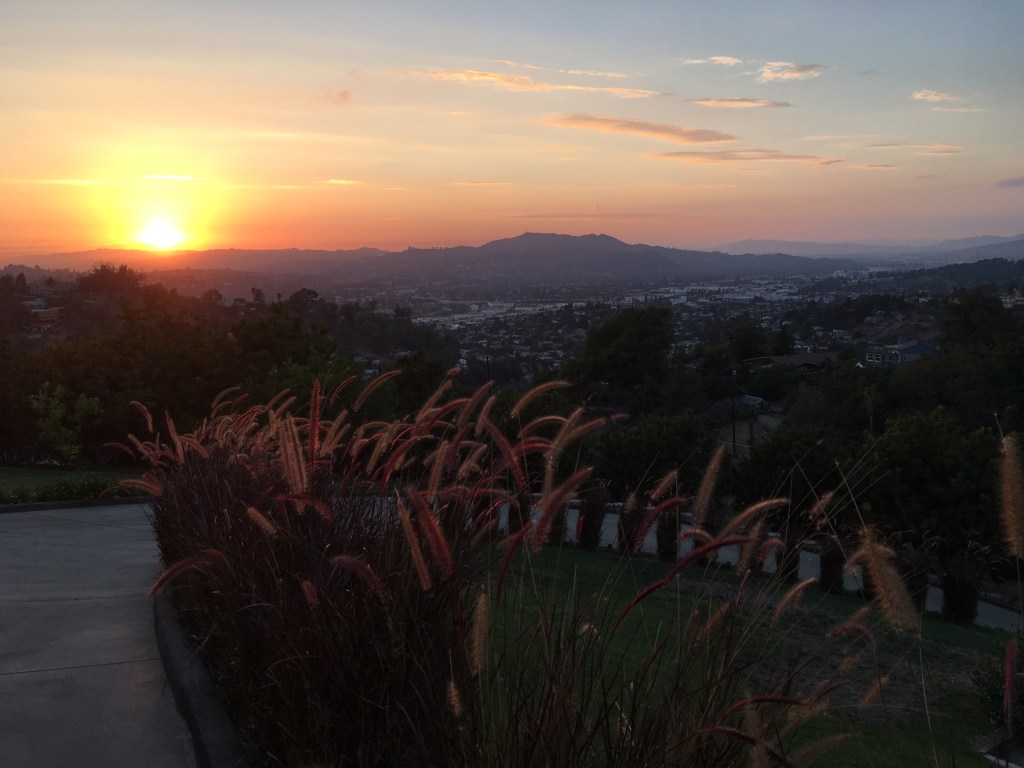
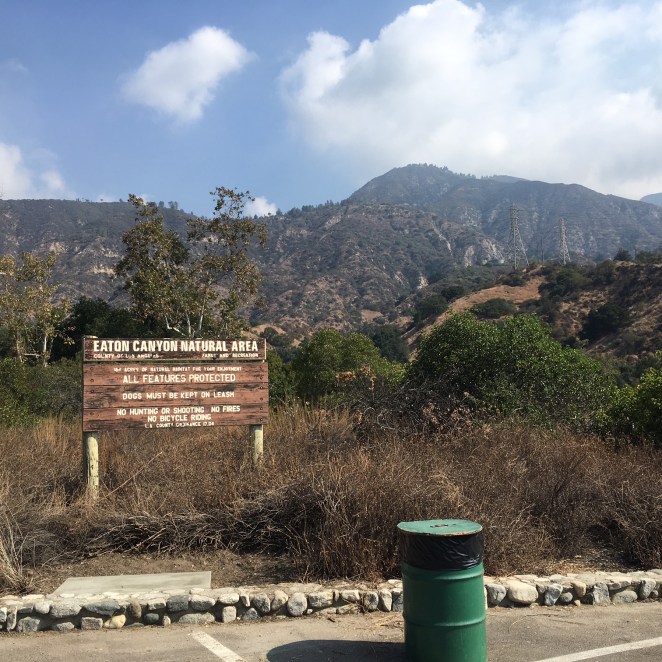
There is also such a wide variety of things to see and do in Los Angeles.  Sure there are plenty of cars and freeways, but there are also gorgeous mountains, canyons, parks, lookout points, hiking trails, bike paths and surfing spots besides the vibrant culture, impressive architecture, phenomenal museums, diverse nightlife and delectable cuisine.  Perhaps the spot I got to in my short stay that was my favourite was the Huntington Library in San Marino, just south of Pasadena.  What a delightful place.  While I admit that I did drive there, it would have been possible to take public transit most of the way, but would likely have taken considerably longer.  I am not the kind of person who usually goes out of his way to see flora and fauna, but the botanical gardens at the Huntington are special.  The grounds are so massive, that there were many occasions while I was exploring the Desert Garden, the Japanese Garden, the Australian Garden, the Rose Garden or the Lily Pad area when I was the only one around.  When it gets too hot (and the day I was there was scorching), you can duck into one of the many air conditioned museums on the grounds such as the American Gallery or the European Gallery.  There are some very famous original works housed here permanently(Gainsborough’s The Blue Boy and Pinkie among them) and impressive temporary collections as well.  A real bonus for me was the library which beautifully displays such rare, early copies of works such as The Canterbury Tales, The Gutenburg Bible, Thoreau’s Walden, and The Declaration of Independence.  Finally, the gift shop is one of the best I’ve ever encountered and requires at least an hour to peruse its beautifully organized displays.  The Huntington Library, like a lot of Los Angeles, was a revelation to me.  Sometimes, you just have to experience a city and not be scared off by the negative hype!

Watching the Blue Jays lately is like…

After Friday’s stinging loss, third in a row, plummeting with no reversal in sight, I posit that hoping the Jays make the playoffs is like being in a relationship with someone way out of your league.  You know she is going to break up with you sooner or later.  What’s the point of getting her to agree to go to the Wild Card Dance (which is looking more and more improbable), if you know she’s going to break your heart a week later?

The entire city feels as if this huge emotional investment for half a year was just dropped down the toilet.  So what do we do?  We act the way we might if we got dumped.  “Oh, I was going to break up with her anyways.  You know, she did so many things that drove me crazy.  This way, I’ll have more time to do important things.  We were in a rut.”  Yeah, right.  Heartbreak is heartbreak and it sucks. (Photo credit:  ctvnews.ca)