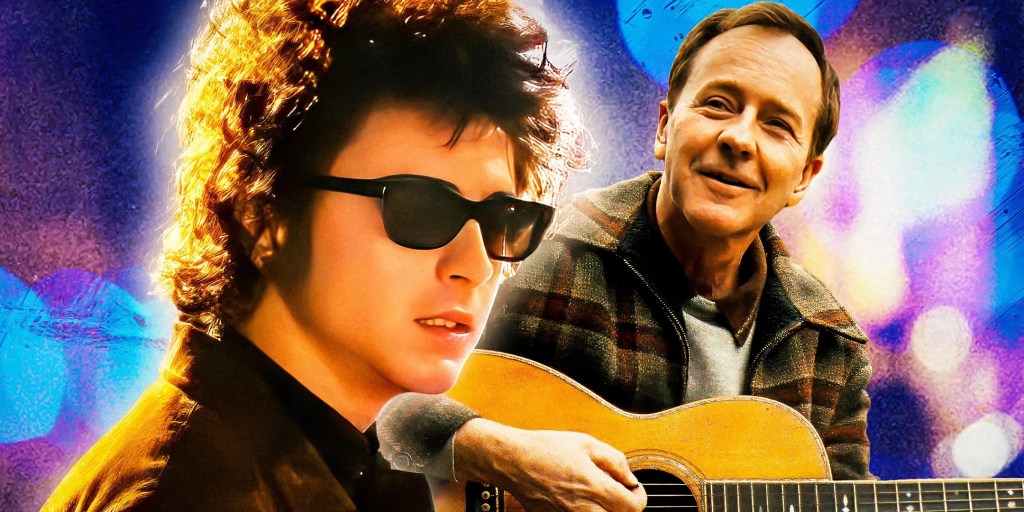
I greatly enjoyed A Complete Unknown, the Bob Dylan biopic starring Timothée Chalamet. For Dylan fans like me, the movie offers little that is new as it covers the well documented time period from Dylan’s 1961 arrival in New York to his performance at the 1965 Newport Folk Festival. The key players in these years are familiar: girlfriend Suze Rotolo (called Sylvie in the movie), fellow folkie Joan Baez, folk legends Woody Guthrie and Pete Seeger, and manager Albert Grossman among them. Dylan’s meteoric rise from the vagabond singer songwriter playing Greenwich Village café basements to the international superstar who could fill concert halls is similarly well trod territory and the movie provides little in the way of fresh revelations. Still, the movie delights, largely because of the uncanny performance of Chalamet as Dylan. Not only does Chalamet nail the look and the smug delivery of lines, but he sings and plays guitar and harmonica in the film. Those people who cannot stand Dylan’s voice might actually consider the fact that it is Chalamet singing as a distinct advantage of the film. His performance is the wonder of the film, though the supporting cast is also terrific.

While the film is certainly based on real events, it would be unwise to believe every scene actually happened as portrayed. Biopics tend to compress and simplify, and this one is no exception. So, while it is generally accepted as fact that Dylan went to visit a dying Woody Guthrie in a New Jersey hospital shortly after Dylan arrived in New York, the subsequent visits and the presence of Pete Seeger might be fictional. But the veering from the actual in no way detracts from the essence of Dylan’s idolization of Guthrie. Similarly, while Dylan was undoubtedly romantically linked to both Rotolo and Baez, the course of those intertwined relationships might differ somewhat from the timing of the film. To its credit though, the film does not alter these to make Dylan admirable. On the contrary, the film does an excellent job of portraying Dylan’s exploitative nature in these relationships. He has no qualms about re-entering the lives of these women whenever he needs them, no matter how much time has passed since his last contact and no matter what ungodly hour of the night it might be. In one particularly revealing scene, Dylan arrives at the Chelsea Hotel in the middle of the night and begins knocking on doors till he finds Baez. Later, when Baez awakes from a post-coital slumber, it is to Dylan playing her guitar and working out lyrics for a new song. She angrily asks if he has come there so she could watch him write. When Dylan refuses to see what she’s upset about, she tosses him out. Like many of the biographies of Dylan, the film suggests he is an incredibly talented artist, but a problematic human being who expected women (at this stage in his life anyways) to stop anything they were doing to be with him. Elle Fanning (as Sylvie) and Monica Barbaro (as Baez) are both fabulous in representing the gravitational pull of Dylan and the inevitable diminishment that comes from being sucked into orbiting him.


Rotolo and Fanning Baez and Barbaro
Of course, the central tension in the film is Dylan versus the traditional folk music community. The film suggests that Seeger helped pave the way for Dylan to be embraced by a ready-made musical community. There can be no doubt that Dylan’s success was accelerated by the existing folk music infrastructure. Right from the start though, Dylan bristles at the simplistic labelling of musicians. In a scene that seems a bit self-conscious, Dylan drags Sylvie to an old Bette Davis movie and then afterwards defends the character’s transformation from Sylvie’s accusations of ‘reinventing’ herself. For Dylan, the character was presenting herself as she needed to be at that moment. Dylan simply would not allow others to label him, whether as a folk musician or a spokesman for a generation. He seems to recoil with indignation when people expect something of him. Which leads to the climax of the film, the 1965 Mariposa Folk Festival in which Dylan shocks the organizers and many of the fans by going electric and playing three songs with a full backing band. This might not seem like much of a conflict, but the film has clearly established how the folk world is run by purists who clearly distinguish between their genre and others. Some of them, like Alan Lomax, feel Dylan has just used the folk genre for personal fame and is now turning his back on it. Though as folk music’s popularity has exploded with Dylan, the question of who is using who is not clear cut.

Edward Norton who turns in a masterful performance as the legendary Pete Seeger
Of course, Seeger saw where Dylan was headed on Bringing It all Back Home, a brilliant album that features both acoustic and electric numbers. Seeger, portrayed in a very likable manner by Edward Norton, seems to just want Dylan to honour the folk tradition one more time at Mariposa, but also likely realizes he is fighting a losing battle. And so, as Dylan zips away on his motorcycle in the film’s closing frames, symbolically leaving behind his early influences, we hear the echo of Johnny Cash’s advice to Dylan “to make some noise, track some mud on the carpet”. For many of us, that muddied carpet has been a sustained joy.
 prose by p. rose
Great review Paul.
LikeLike
Hi Paul:
I enjoyed your review of the recent Bob Dylan movie. We plan to see it when we are in Toronto next week for a few days. (Don is meeting with a potential Gallery Owner.) I like the name “Prose by Rose” too!
All the best to you both in 2025,
The other Jan.
LikeLike