
I recently saw two Mirvish musicals in the space of a week. For some, that would generate excitement, and for others, a sense of pure terror. For me, the result was somewhere in between. The two musicals in question are Moulin Rouge, currently playing at the CAA Ed Mirvish Theatre and Titanique which can be seen at the CAA Theatre. And yes, if the names of the theatres are confusing, the former has entrances on Yonge and Victoria streets, south of Dundas, while the latter is on Yonge, south of Bloor.
To be honest, I wasn’t particularly hopeful heading in to either of these musicals. I had heard mixed mutterings about Moulin Rouge, and I still haven’t seen the film Titanic, so it is clear I am not exactly the target audience for either of these shows. Moulin Rouge is set in the reknowned Parisian night club associated with the cancan. Titanique, meanwhile, is set on the ill-fated R.M.S. Titanic.
I left Moulin Rouge feeling quite bleak about the future of the musical genre, but left Titanique reassured somewhat that there might still be hope.
Moulin Rouge has the advantage of a bigger stage, better sound equipment, and a splashy marketing campaign; it manages to squander these in a staggering way. The plot is thinner than cup-a-soup. And yes, I am aware that no one goes to a musical expecting exposition worthy of Miller or Williams, but this felt like it might have been cooked up by middle school students serving detention. Somehow, we are expected to believe that the Parisian night club is in such financial trouble that Harold Zidler, the emcee and possible owner of the club (a fact that is never really made clear), will have to shut it down unless he can get his star Satine to seduce The Duke of Monroth into injecting huge amounts of cash into the operation. Satine, however, has fallen for an American songwriter named Christian, who she at first mistakes for the Duke. Oh, and by the way, she is dying of consumption, but is still able to go onstage in ridiculously tight outfits and sing and dance like a whirling dervish. The T.B. produces a light cough now and then but doesn’t stop her from show stopping routines. But the plot isn’t even the show’s biggest weakness. That honour is held by the characterization which is shockingly shallow. Part of the problem is that the characters are so busy singing bits and pieces of about seventy-five different songs that are supposed to reveal how they feel, they don’t have time to engage in any conversation. And when I say bits, I mean sometimes it is just a single line of a song. For much of the evening, I felt like I was at some abortive karaoke night. In addition, much of the characterization is just lazy. Rather than having the actors incrementally reveal their personalities and motivations, we are just told about them by other actors. We are told that the Duke is vicious and not the kind of person you want to cross; we are similarly told that Satine was born in poverty and had no choice but to sell her body to survive the mean streets. Nothing in their performances is subtle. The real sticking point for me though was the unbelievable love affair between Satine and Christian.
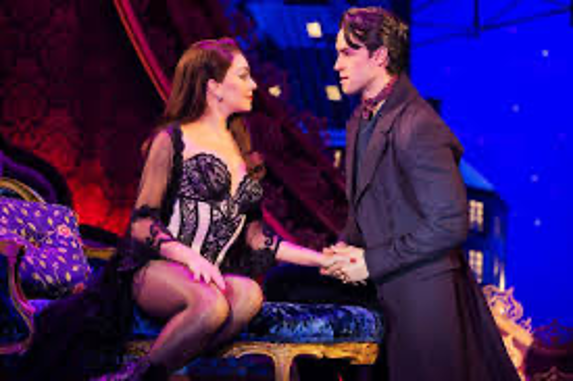
They hardly know each other but are somehow smitten. At least in tradtional romantic musicals, the leads can sing whole songs to try and reveal their feelings. Here, we get little snatches of songs, so the relationship seems even more tenuous. I am not arguing with the quality of the singing and dancing, nor the costuming and lighting which certainly attracts our attention. But to actually expect us to care about any of these characters is a big ask. Summing up the insignificance of the show’s plot is the ending which immediately dropkicks the somber tone with a high octane curtain call that screams to the audience: “Never mind about the plot, we’re going to sing and dance again.” What depressed me the most was that the audience members, or a good many of them, seemed enthralled and were on their feet. Though as a standing ovation is the norm these days, it is perhaps difficult to judge exactly how thrilled the crowd was. Still, if this is the future of musicals, why not dispense with the plot altogether and just sing and dance?
To say that I am not a Celine Dion fan is an understatement of epic proportions. Scrutinizing my program and learning that the main character in Titanique is Celine Dion (as played by Veronique Claveau) led me to some pre-traumatic stress. Was I ever wrong. The play is basically Celine Dion hijacking the Titanic museum tour with her memory of what really happened on the ship, which is to say what really happened with the Rose and Jack love story that is the core of James Cameron’s iconic film. The premise is ridiculous because though she sings “My Heart Will Go On” in the film, Celine Dion was born in 1968, 56 years after the sinking of the ship. But this production embraces the inanity of its plot, whereas Moulin Rouge tries to dance around it. Claveau is marvellous as Dion; not only does she have a lovely voice, but she has perfected the singer’s speech mannerisms, Quebecois English and her facial expressions. It’s hard not to laugh when Claveau interacts with audience members and nails the ego of Dion that is somehow made less caustic because of her eccentric wording. The supporting cast was equally strong, and this was on a night when both Rose and Jack were being played by standby performers.

Christopher Ning as The Seaman/Iceberg Bitch/Tour Guide and Peabo Bryson (how’s that for a collection of roles?) was fantastic, and so was Constant Bernard in the role of Rose’s mother Ruth. The Iceberg Bitch role features the stout Ning in Tina Turner costume replete with high heels, singing and dancing with Turner’s trademark energy. The show works because it doesn’t take itself seriously. The cast make a point of skewering the shallow nature of musicals; at one point, shortly after meeting Rose, Jack responds after a few seconds of dialogue, “Well, now that I’ve got to know you” and then breaks into song. Even the audience advisory is lighthearted warning of some coarse language, sexual innuendo, rowdy humour, and A LOT OF CELINE DION MUSIC. One of the problems some of the performers faced was headset microphones that were unresponsive at times and emitting static at others. When Erica Peck who is playing Molly Brown is struggling with her microphone trying to sing “All by Myself”, Bernard hilariously improvises and joins her in a short lived duet before she asks him what he’s doing. This was just one moment of what seemed like a fair bit of improvisation that suited the moment and the unexpected technical glitches. The actors sure looked like they were having fun, as opposed to the cast of Moulin Rouge with their polished lines and plastic smiles. Whereas Titanique featured lines that referenced Toronto in Commedia Dell’arte fashion, the only local mention at Moulin Rouge was after the show when the cast was trying to do some fundraising. While the Parisian club is supposed to represent a legendary kind of raciness, there was much more edge to the fast paced dialogue and the eggplant prop in Titanique than in the “Lady Marmelade” lyrics and gyrations of the performers trying to set the tone in Moulin Rouge. It wasn’t just all comedy. The performers could really sing, especially Ning, Peck and Kaylee Harwood who played Rose. And the script was every bit as demanding physically as the dance numbers in Moulin Rouge. But it was the comedy in the form of body language, facial expression, writing that poked fun at both Cameron’s film and the musical genre, and the local references that made the show memorable. Perhaps the lesson here with musicals these days is that as tired as the genre is, there are always ways of reinventing it to entertain.
 prose by p. rose
Hi Paul,I enjoyed your article. It made me laugh. I go to a lot of theatre and saw Moul
LikeLike